
Promoting LAW not War at the first week of the NPT Review Conference
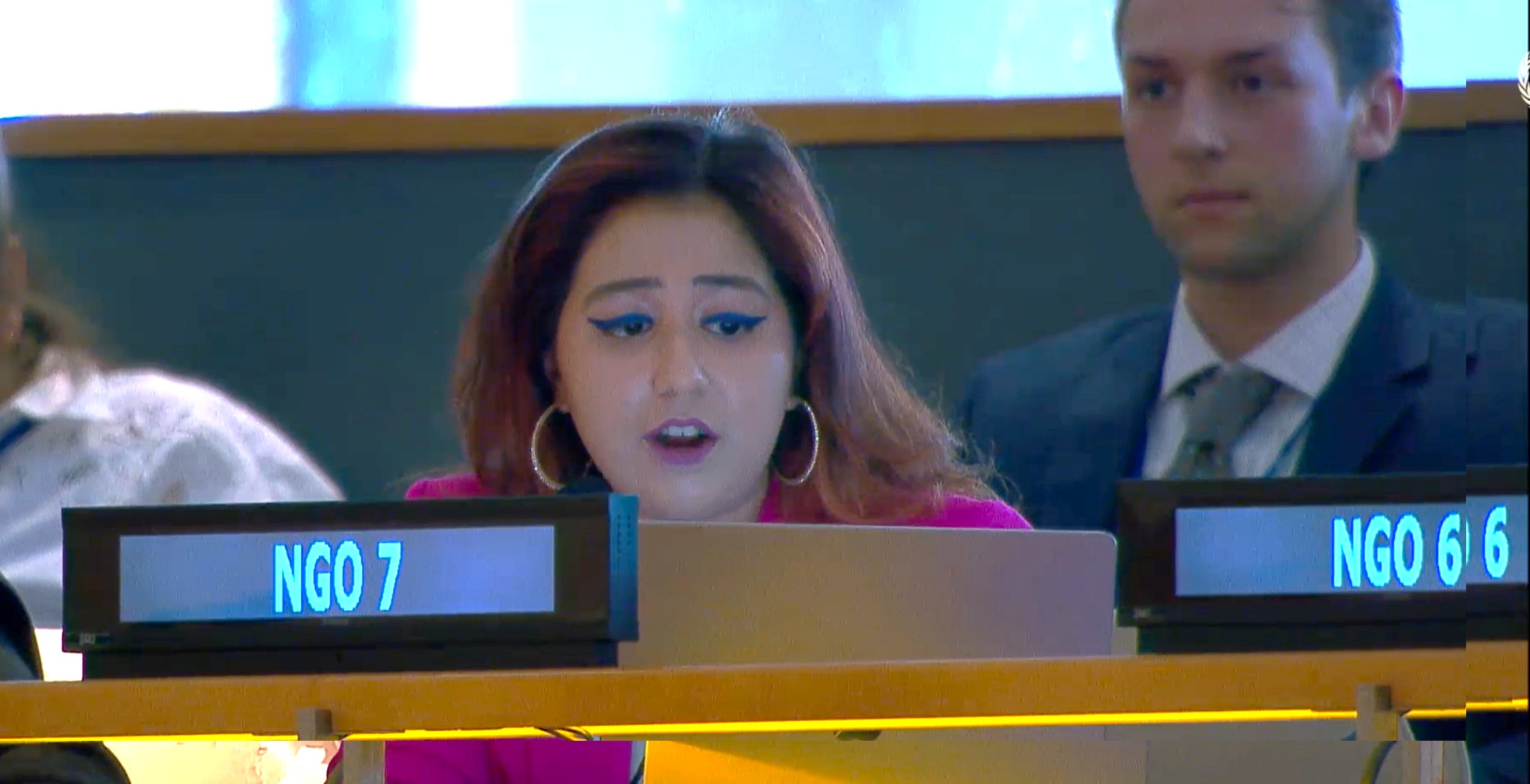
“Promoting credible alternatives to nuclear deterrence – including to prevent aggression – is critical to global security for current and future generations,” asserted Kehkashan Basu, Co-President of the World Federalist Movement-Institute for Global Policy (WFM-IGP), speaking to the States Parties to the Nuclear Non-proliferation Treaty (NPT) at the United Nations on May 1, 2026.
The NPT States Parties are meeting for four weeks (April 27-May 22) to discuss nuclear risk reduction, nonproliferation and disarmament. The NPT Review Conference comes at a time of armed conflicts involving nuclear armed and non-nuclear States (Russia’s invasion of Ukraine and the US-Israel military attacks against Iran), and a renewed nuclear arms race between the nuclear-armed States.
WFM-IGP, Parliamentarians for Nuclear Nonproliferation and Disarmament (PNND) and other UNFOLD ZERO member organizations are actively promoting Legal Alternatives to War (LAW not War) and common security at the NPT Review Conference as important in ending war and providing credible alternatives to nuclear deterrence.
“Common security offers a practical framework, based on the understanding that lasting security depends on addressing the concerns of all states, including adversaries,” suggested Ms Basu to the States Parties to the NPT. “It emphasizes diplomacy, negotiation, mediation, and the application of international law to prevent conflict and resolve disputes.”
“The UN Charter provides clear avenues for peaceful resolution of conflicts, including mediation, arbitration, and adjudication,” continued Ms Basu. “Strengthening these mechanisms, including broader acceptance of the jurisdiction of the International Court of Justice, is essential to reinforcing a rules-based international order.”
- Read the full presentation of Kehkashan Basu.
LAW not War and the US-Israel conflict with Iran:
Common security and the role of the International Court of Justice to advance LAW not War were also promoted at the May 1 plenary session by Bill Kidd, Co-President of PNND; and Rebecca Shoot, PNND Senior Adviser and Co-convenor of the ImPact Coalition on Strengthening the International Judicial Institutions.
“We need to strengthen the roles of the UN General Assembly, International Court of Justice (ICJ) and International Criminal Court (ICC) to prevent – and build accountability for – acts of aggression,” urged Mr Kidd to the States Parties to the NPT. “And we need to support the establishment of additional nuclear-weapon-free zones, especially in the Middle East. In these ways we can replace the reliance on nuclear deterrence with reliance on common security.”
Mr Kidd submitted a proposal by PNND Council Member Jonathan Granoff to the NPT Review Conference, that could end the US-Israel v Iran war and strengthen the NPT.
“The proposal, which has been covered by Newsweek (War Won’t Solve Iran’s Nuclear Threat. This Could, April 25, 2026), advocates making comprehensive inspection safeguards, much like the JCPOA and the Chemical Weapons Convention, apply to all non-nuclear weapons States parties to the NPT, not just Iran,” explained Mr Kidd. “This would make the world safer, stop the next North Korea, and allow both the USA and Iran to rightfully claim a victory for the world. It would also strengthen the legitimacy of the NPT regime by reinforcing its nonproliferation pillar.”
“It is also the 80th anniversary of that Court (ICJ) itself—an institution created to uphold the rule of law at the international level, even in the most consequential matters,” noted Ms Shoot. “At a time of rising risk and eroding trust, the choice before us is stark: allow instability to dictate outcomes, or summon the political courage to reinforce law, rebuild cooperation, and advance disarmament with seriousness of purpose.”
- Read the full presentation by Bill Kidd
Legal imperative to achieve a nuclear-weapon-free world
“2026 marks the 30th anniversary of the Advisory Opinion of the International Court of Justice on the legality of the threat or use of nuclear weapons—an opinion that underscored both the profound legal constraints on these weapons and the obligation to pursue and conclude negotiations leading to complete nuclear disarmament,” reported Ms Shoot.
“The indefinite retention of nuclear weapons cannot be reconciled with an obligation to conclude
negotiations for their elimination,” pronounced Dr. Deepshikha Kumari Vijh, Executive Director of Lawyers Committee on Nuclear Policy, to the NPT plenary. “Nor can doctrines premised on perpetual readiness to inflict mass destruction be squared with the principles of humanity or the imperative to safeguard future generations. The survival of humanity demands movement from rhetoric to negotiations, from negotiations to implementation, and from implementation to abolition.”
Nuclear Abolition Day Appeal:
Ms Shoot also presented the Nuclear Abolition Day Appeal to the NPT plenary. The Appeal, which was drafted by NuclearAbolitionDay.org, has been endorsed by more than 670 organizations and 1400 additional individuals from 101 countries, including Nobel Laureates, former high level officials (foreign ministers, UN Officials…), parliamentarians, local body representatives, other political leaders, academics/scientists, religious leaders, medical professionals, youth leaders, educators, business leaders, artists and other members of civil society.
The Appeal calls on States to affirm the inadmissibility of the threat or use of nuclear weapons, stand down nuclear forces, pledge to achieve the global elimination of nuclear weapons no later than 2045, cut nuclear weapons budgets and reinvest these funds in peace, climate protection and human security.
- Read the full presentation by Rebecca Shoot
Urgent need for nuclear-risk reduction:
The urgent need for nuclear risk reduction measures – to prevent a nuclear war by escalation, miscalculation or accident – was highlighted by John Hallam, PNND Australia Coordinator and Co-convenor of the Abolition 2000 Nuclear Risk Reduction Working Group.
“Nuclear armed states continue to threaten the use of nuclear weapons, including in a wide and opaque range of scenarios, and to prepare for such use, including by placing weapons systems on high readiness to use and by maintaining policies providing for the first use of nuclear weapons in a conflict,” noted Mr Hallam.
He reminded NPT delegates of the declaration Nuclear Taboo: From Norm to Law, endorsed by over 1100 notables and presented to the 2023 NPT Prep Com, which calls specifically on the NPT to “enshrine the norm of non-use of nuclear weapons as a dictate of international law and to require all member states to comply fully, in order to ensure their security policies and practices rule-out the initiation of nuclear war including any first-use of nuclear weapons.”
NoFirstUse Global submitted a working paper to the 2022 NPT Review Conference, entitled No-First Use of Nuclear Weapons: An Exploration of Unilateral, Bilateral and Plurilateral Approaches and their Security, Risk-reduction and Disarmament Implications, which provides practical approaches for taking forward such policies.
- Read the full presentation by John Hallam
Upcoming events:
UNFOLD ZERO and PNND will continue to engage in the NPT Review Conference in its second week (May 4-8), including by organising a side event Can Common Security replace Nuclear Deterrence? on May 5 and a side event A Nobel Effort: The Roles and Actions of Parliamentarians to support Diplomacy, Disarmament and International Humanitarian Law on May 6.
There will also be a Nuclear Abolition Day side event on May 8 to follow-up on the presentation of the Appeal to the NPT and prepare for the International Day for the Total Elimination of Nuclear Weapons on September 26.
Photo: Kehkashan Basu speaking to the NPT plenary in the UN General Assembly Hall on May 1, 2026