
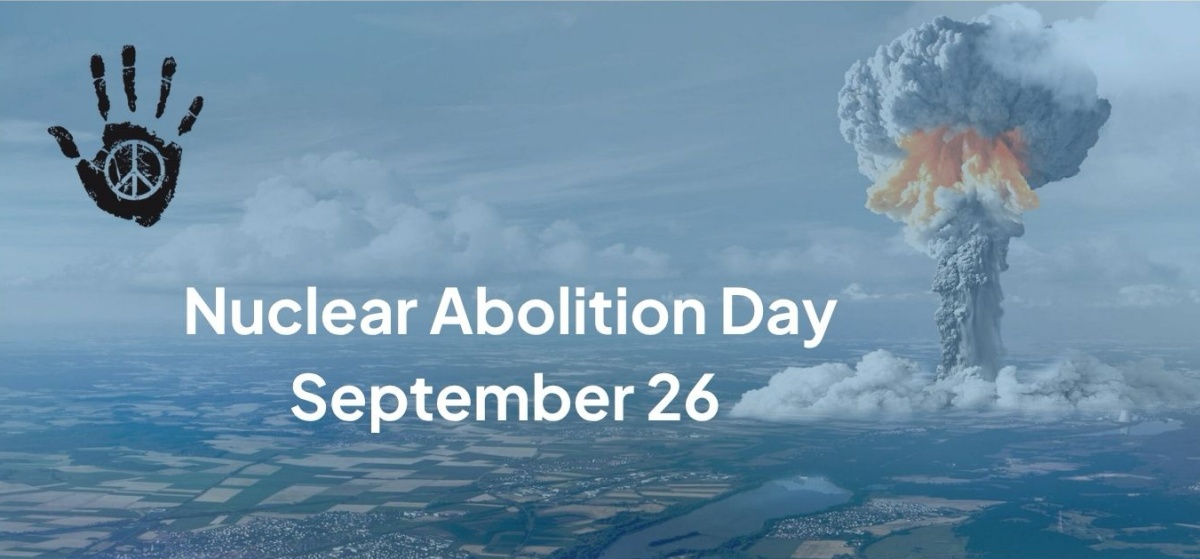
September 26 has been established by the UN General Assembly (UNGA) as the International Day for the Total Elimination of Nuclear Weapons (Nuclear Abolition Day).
On September 29, 2026, the President of the UNGA will convene a high level meeting at the UN to commemorate this shared goal, and where world leaders will address the question: How can we end the threat of nuclear war and achieve the global abolition of nuclear weapons? Making progress on these goals is imperative for the future of humanity.
Over 2000 diverse organizations and eminent individuals from 105 countries have endorsed a powerful plea – the Nuclear Abolition Day Appeal – to strengthen restraints against any use of nuclear weapons and to achieve the elimination of these horrific devices no later than 2045. This appeal will be presented to the nations of the world at the General Assembly on the 29th.
On September 26th, a global, civil-society webinar Towards a Nuclear Weapons-Free World, will commemorate Nuclear Abolition Day and discuss calls made in the Appeal.
The September 26th event, which spans across all time zones, will be opened by a message from H.E. Izumi Nakamitsu, UN Under-Secretary-General and High Representative for Disarmament Affairs, and will include Nobel Laureates, current and former high-level political officials, parliamentarians, local body representatives; academics and educators; scientists; medical professionals; leaders from faith-based, business, and youth communities; artists; and other concerned individuals and organizations. There is sobering reality of which this extraordinary group is deeply concerned: by accident, miscalculation, misinformation, crisis escalation, or malicious intent, the use of nuclear weapons is an imminent threat. We must not ignore it.
As Ela Gandhi, Co-President of Religions for Peace, granddaughter of Mahatma Gandhi, and one of the event speakers, notes: “Nuclear weapons are a hazard for all of humanity and therefore should be dismantled and abolished altogether from the face of our Earth, our planet, our home.”
The program will also premiere the global screenings of the new Oscar-nominated short film, An Ordinary Insanity, featuring renowned whistleblower Daniel Ellsberg, followed by discussion with the film director and producer. Before he released the top-secret Pentagon Papers during the Vietnam War, Ellsberg was a nuclear war planner with access to classified information on US nuclear strategy. Filmed a year before his death in 2023, this film provides a powerful wakeup call from Ellsberg: “I’ve long said that to my last breath I will be doing what I can to postpone and avert the risk of nuclear war.”
September 26th is also the anniversary of an infamous incident when a nuclear war was nearly initiated by misinformation. On this date in 1983, a nuclear weapons early warning facility in Russia detected an apparent incoming ballistic missile attack from the USA (later confirmed as a false alarm). Colonel Stanislav Petrov, Duty Officer at the facility, broke protocol by not affirming to senior command that the early warning satellites were detecting incoming nuclear missiles, thus preventing a possible ‘launch-on-warning, retaliatory nuclear strike’ from Russia, which would have triggered nuclear war.
Colonel Stanislav Petrov’s brush with the apocalypse isn’t the only such incident in which courageous (and sometimes career-ending) commonsense decisions have been made by military personnel under extraordinary stress – some known, some unknowable. The future of civilization cannot rest in our reliance on brave individuals being in the right place at the right time. States must move to sanity for our safety.
“The risk of nuclear war, whether triggered by deliberate aggressive first use, or – probably more likely – through accident, system error, cyber sabotage, or human error or idiocy, is as great or greater now than it has been since the height of the Cold War,” says Hon Gareth Evans, former Foreign Minister of Australia, Convenor of Asia Pacific Leadership Network on Nuclear Non-Proliferation and Disarmament, and a speaker at the September 26 event.
Nuclear Abolition Day also highlights the exorbitant nuclear weapons budgets, and how these funds could better support peace, environment protection, economic development and other human needs. The Appeal promotes common security and international law to address the existential threats from both nuclear weapons and climate change.
“It is in response to the continued prevalence of human-generated threats to humanity, from nuclear weapons to the climate emergency, that the law acts as a shield to protect all of humanity, including present and future generations,” says Theresa Amor-Juergenssen, World’s Youth for Climate Justice. “On these fronts, the law is clear: as a species we must pool our efforts, setting aside transitory interests, to stop humanity’s hubris and prevent intergenerational threats from destroying all life on Earth.”
“We need to elevate diplomacy, cooperative leadership, common security and the rule of law in order to prevent nuclear war, resolve international conflicts peacefully, protect the climate for current and future generations and set in motion concrete processes to achieve the peace and security of a nuclear-weapon-free world,” concludes Bill Kidd, Co-President of Parliamentarians for Nuclear Nonproliferation and Disarmament and an event speaker.
Appeal supporter Michael Douglas, Academy Award-winning actor and UN Ambassador for Peace sums up our duty: “We must all do our part to ensure that – by accident, design or madness – these weapons are never used. This time of turbulence compels a clear message to stop threatening all of our lives and our children’s future. Nuclear disarmament now.”
Please join on September 26 for the event and an opportunity for existential course correction.
**********************************************
Organized by NuclearAbolitonDay.org, a global civil society coalition established in consultation with the UN Office of Disarmament Affairs in 2025 to build cooperation and impact for the International Day for the Total Elimination of Nuclear Weapons.